
How is this different from a sidewalk?
Why is it precast?
Sidewalks and boardwalks have different applications, installation methods, and use cases. Learn about all of them here.
Short on time? Here's what you need to know.
- Sidewalks are poured in place, requiring concrete trucks, curing time, and optimal weather conditions.
- Boardwalks and walkways from TerraTread are pre-cast, meaning they are already cured, and can be installed regardless of weather.
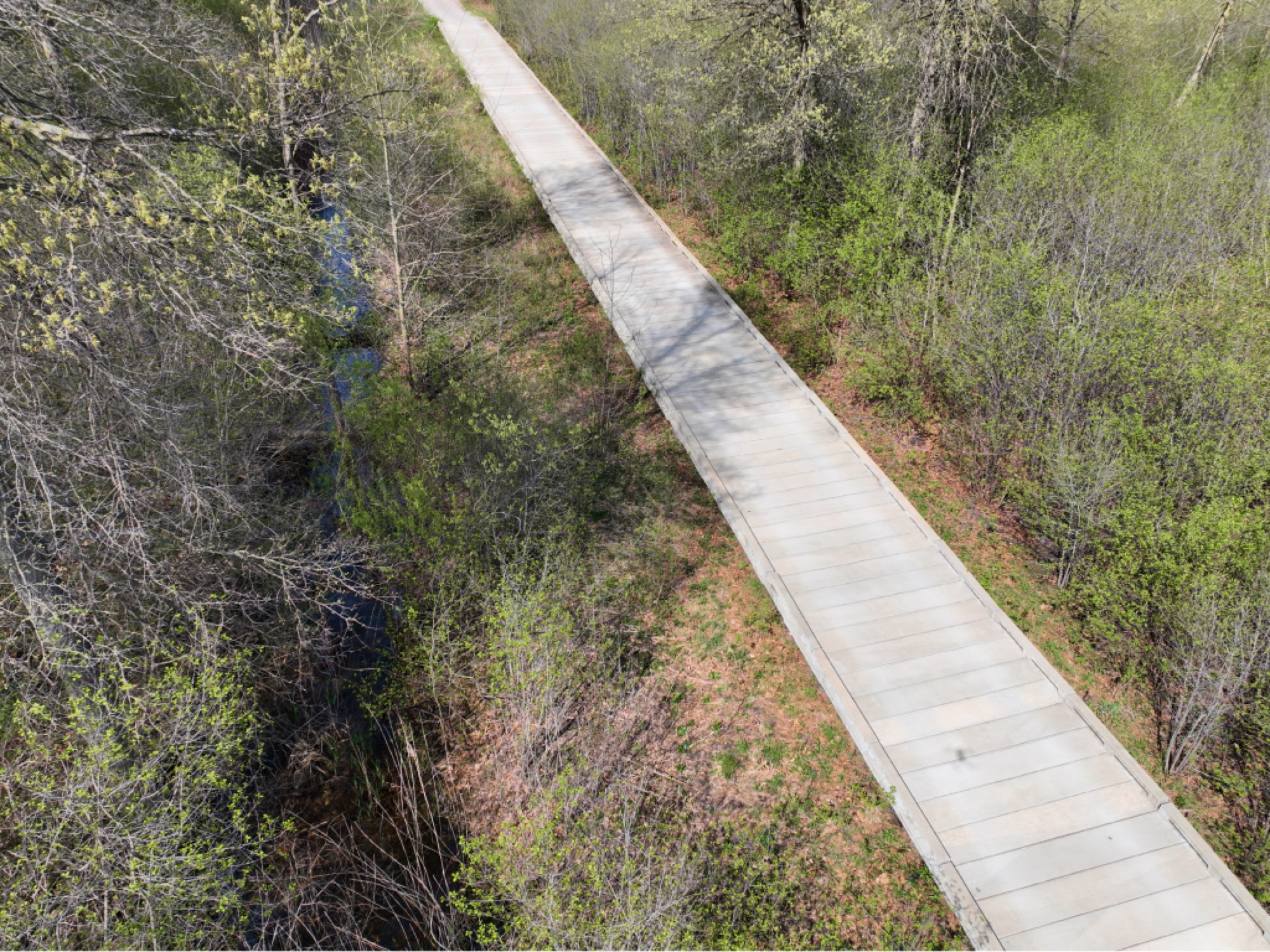
- TerraTread can be placed in hard-to-access or sensitive areas, such as over wetlands, in forests, on historic sites, and in other places where concrete trucks would not be able to access.
- TerraTread can be placed over helical piles, making it an ideal option for areas where water is a concern or elevation changes.
What makes TerraTread boardwalks and walkways different from a sidewalk? Why are they precast?
The primary differences between concrete boardwalks and sidewalks are casting methods and installation applications.
Sidewalks are usually poured in place. After the excavation and base are complete, the concrete is poured directly at the site. This requires relatively flat land with enough space for a concrete truck to maneuver and pour concrete.
While sidewalks can be poured in accessible places, such as beside a road to provide a place for pedestrian traffic, they can’t be poured in a sensitive habitat, like a wetland or marsh.
In contrast, TerraTread boardwalks are pre-cast, meaning they require no on-site curing and can be placed in hard-to-reach areas, like over wetlands, bodies of water, and in sensitive environments where traffic should be minimized.
While sidewalks require excavation and a continuous foundation, TerraTread can be installed atop helical piles wherever necessary, making it a great choice for changing elevation or environments where water is a concern.
 BEST CHOICE
Precast Boardwalk or Walkway
- Can be installed in most weather conditions
- Is pre-cured before install
- Can be placed in difficult-to-access areas, such as over wetlands
- Often elevated or supported on piles
- Able to traverse sensitive conditions or uneven terrain
- Engineered for park vehicles, maintenance equipment, or even emergency vehicles (depending on the system)
- Precast means minimal disturbance to wetlands, dunes, parks, and natural habitats
Sidewalk
- Can only be installed above 40°F and below 90°F. Rain can disrupt the curing process
- Needs curing time on-site
- Must be accessible to concrete trucks
- Typically poured directly on a compacted subgrade
- Best for streets, neighborhoods, and urban areas
- Designed for foot traffic
- Requires excavation, grading, and a continuous foundation
PROJECT GALLERY


Your future boardwalk
starts here.
More like this


Frequently asked questions
Precast concrete is a construction product produced by casting concrete in a reusable mold or form in a controlled environment, then curing it and transporting it to the construction site. This ensures consistent quality, strength, and faster installation.
Precast concrete offers better quality control, faster installation times, reduced site disruption, and improved durability. It is especially ideal for remote or environmentally sensitive locations.
No. Our boardwalk surfaces are finished with a textured, slip-resistant pattern that meets or exceeds safety standards for pedestrian walkways, even in wet conditions.
Unlike wood or composite materials, concrete does not rot, warp, splinter, or require chemical treatment. It is fire-resistant, has a much longer lifespan, and requires significantly less maintenance.
Yes. Our elevated boardwalk systems are designed to minimize ground disturbance, utilizing top-down construction, making them ideal for wetlands, coastal dunes, and protected ecosystems.
With proper design and installation, precast concrete boardwalks can last 60-75 years or more, far outlasting wood and composite alternatives.
Yes. Our treads are engineered for dual use. This versatility ensures visual consistency and simplifies project design.